Make bugs not war
Thoughts (and links) on why and how to cultivate insect life.

The wonderful writer Olivia Laing (of A Garden Against Time and other things) shared some screenshots in an IG story the other day, snippets of a piece published in the FT Weekend edition dubbed “Refuge or reality? Olivia Laing on gardening in the permacrisis.” I’m not a Financial Times subscriber, so all I know of it were the snippets shared, but I can tell you it’s about the flawed question of whether a garden is a place to escape the world, and that Laing considers the garden a place to think more clearly about it. I found myself reading these sentences over and over:
“This is the real power of gardening: as a mode of expression that keeps on giving, as an act of collaboration that is endlessly surprising. The disappointments are legion, but that’s why it’s so enriching as a process. You’re a participant, rather than a dictator or a king, surrounded by a buzz of fellow citizens of many different species. I don’t know the antidote to war, but I can’t help thinking the world would be far more peaceful if we could all grasp the pleasures of that.”
There’s no doubt in my mind that our increasing disconnection from nature and the ground we all walk on is at the root (sorry) of our problems as a society, and that being “a collaborator” in a garden is a transformative, mind-expanding, life-affirming act. Study after study has shown us what any gardener already knows in their bones on that count. But what I have on my mind more and more is that bit about, as Laing put it, being “surrounded by a buzz of fellow citizens of many different species.”
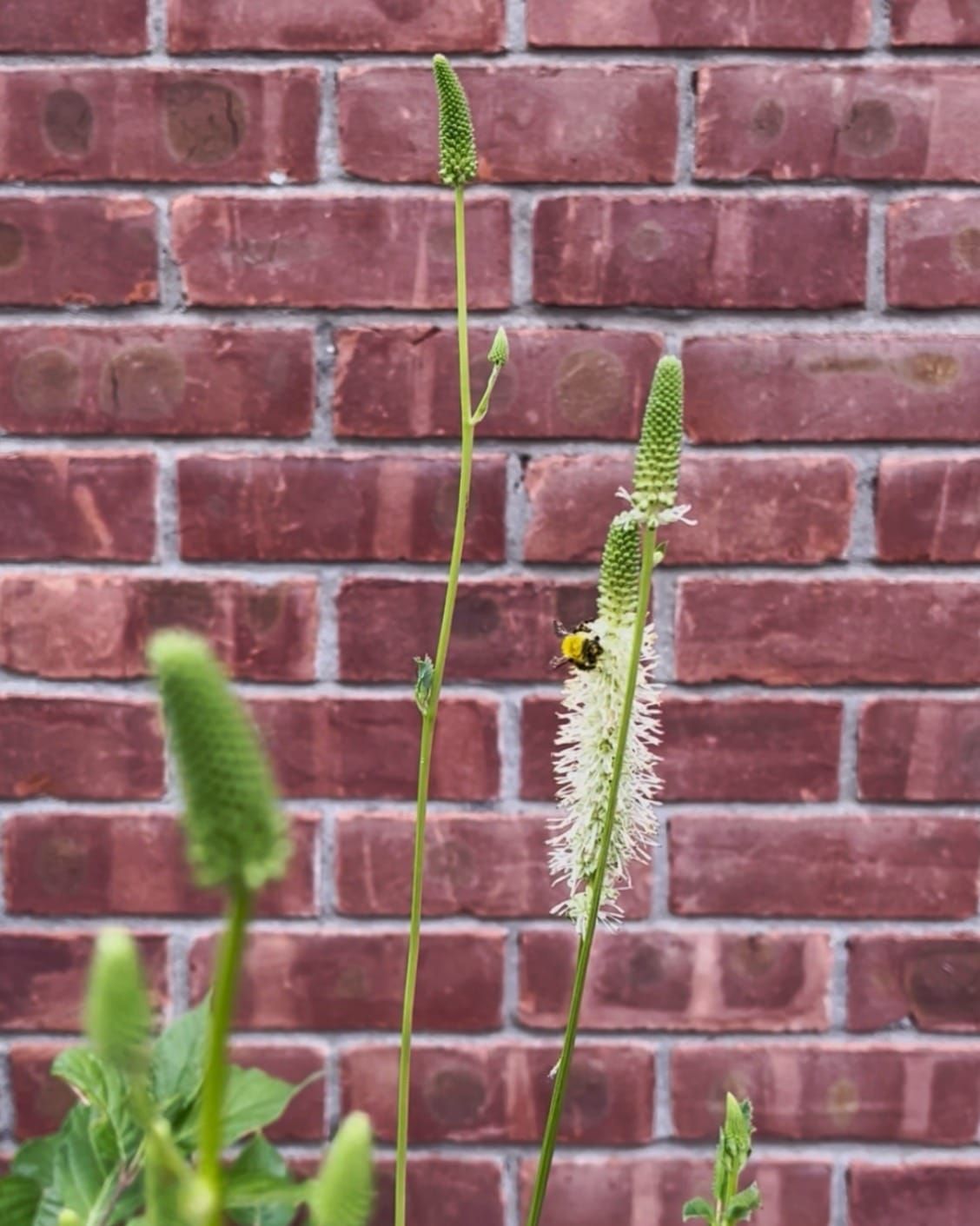
When I was first putzing around the abandoned garden behind the little house we had rented in Napa CA in the early aughts, having no clue what I was doing — just pulling up dead stuff and weeds and seeing what was underneath (sweet peas, mostly) — I admit I was initially a little skittish of the bees. But another thing any gardener will tell you is how quickly you learn that the bees are busy, and as long as you do your thing and let them do theirs, it’s a beautiful, beneficial dance.
In her book A Garden Can Be Anywhere, Lauri Kranz talks about a client of hers who asked her to remove the African basil plant that Kranz puts in every kitchen garden she makes specifically because it so successfully draws bees to the beds. The client was afraid of the bees and so wasn’t keeping up with the garden. Kranz of course tried to explain that without bees, she might as well not bother. And I think most gardeners are pretty crystal clear on the role that pollinators play in the garden, how important that symbiosis is. But we’re now in the midst of this collective mindset shift away from 20th-century derangement (in retrospect) about lawns and chemicals and making our outdoor spaces as insect-free as possible. The more we learn and think and talk about the impacts to us and the environment of the resulting collapse in the insect population, the more we’re coming to realize that ecologically minded gardening isn’t only about cultivating plants that are specifically welcoming to a vast array of insects — although it absolutely is that! It’s also about actively cultivating insects. Giving them not only nectar and host plants but shelter and other considerations.
In an ecological garden, rather than seeking out “pest-free” garden plants, we plant native things because they will be nibbled on by various bugs and butterflies, because they are the one plant a given creature needs for laying its eggs, or because they attract the birds and bugs that feast on the bugs we don’t want, creating a balanced ecosystem. Of course, none of this is revolutionary thinking — it’s relearning ancestral and indigenous knowledge that was lost in the sub/urban quest for a sterilized outdoors. But it seems like every single day, I’m clued into another aspect, large or small, of how that must impact my thinking about making and maintaining a garden — from initially choosing beneficial plants, to leaving the leaves in the fall, the seedheads and skeletons into late winter, and the hollow stems in the spring.
I saw Laing’s snippets on Tuesday afternoon, in the wildly stressful hours before Trump’s scheduled obliteration of “an entire civilization,” human and beyond. Like Laing, “I don’t know the antidote to war.” I don’t know how to keep men from making and aiming weapons at each other and the rest of us. I can’t single-handedly stop the climate from collapsing, or society from cratering. All I can do is raise my voice about all that, lean into community, and do everything I can to support a diversity of life in “my” little rectangle of earth. “A participant” — a caretaker — “rather than a dictator or king.”
LINKING ABOUT IT:
• Shoutout to planitwild for those last three valuable links above, and consistently having the most accessible little explainers I know. Definitely recommend following if you’re not already.
• I recently referenced the ‘chop and drop’ method via The RHS, of chopping those remaining stems into mulch when the time comes. I just want to reiterate, as seen in the planitwild link above, that it is important to wait until it’s been consistently warm enough (above 50º) that baby insects will have left the stems before you start chopping them up. And same goes for the leaf litter.
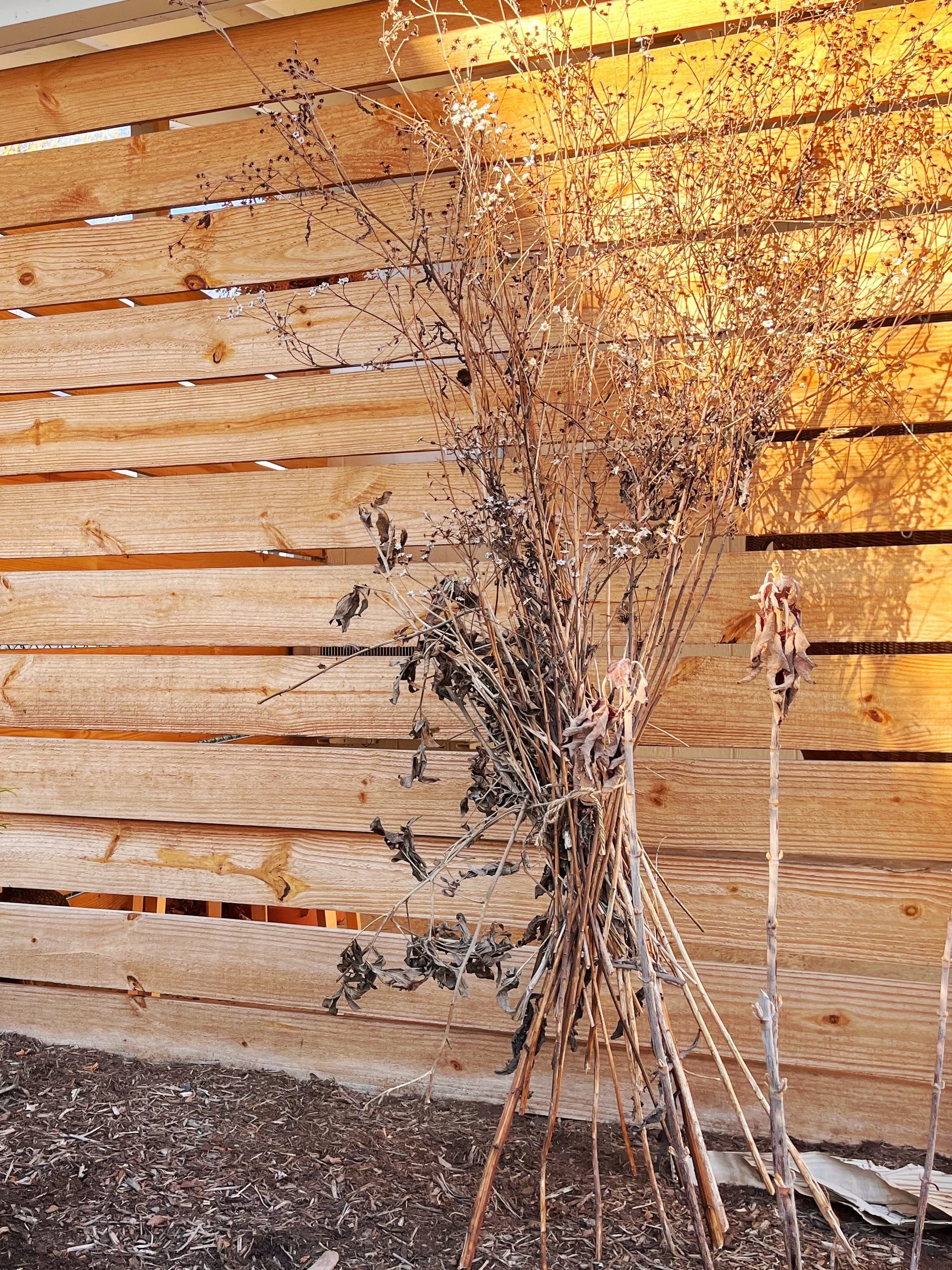
• However, there’s also no actual need for those dead, hollow-stemmed incubators to remain attached to their roots in the meantime. Here’s another tip on how to cut them whenever you do. And I’ve been inspired seeing Poppy Okotcha and others cutting their dried stems and fashioning them into bouquets or bundles of various sorts within the garden, where they can continue to shelter whatever may be nesting within the stems, while making way for new growth on the plants.
• I also fell down the rabbit hole of beautiful bug hotels on Pinterest recently and can’t wait to explore this more. Gardening and knolling rolled into one? Sign me up.
• On the flip side, here’s a hot tip I ran into the other day: Did you know milkweed, the critical host plant for monarch butterflies, happens to also be toxic to invasive lanternflies? Win/win.