On My List: Standout shrubs
Look at these hardworking, beneficial beauties.

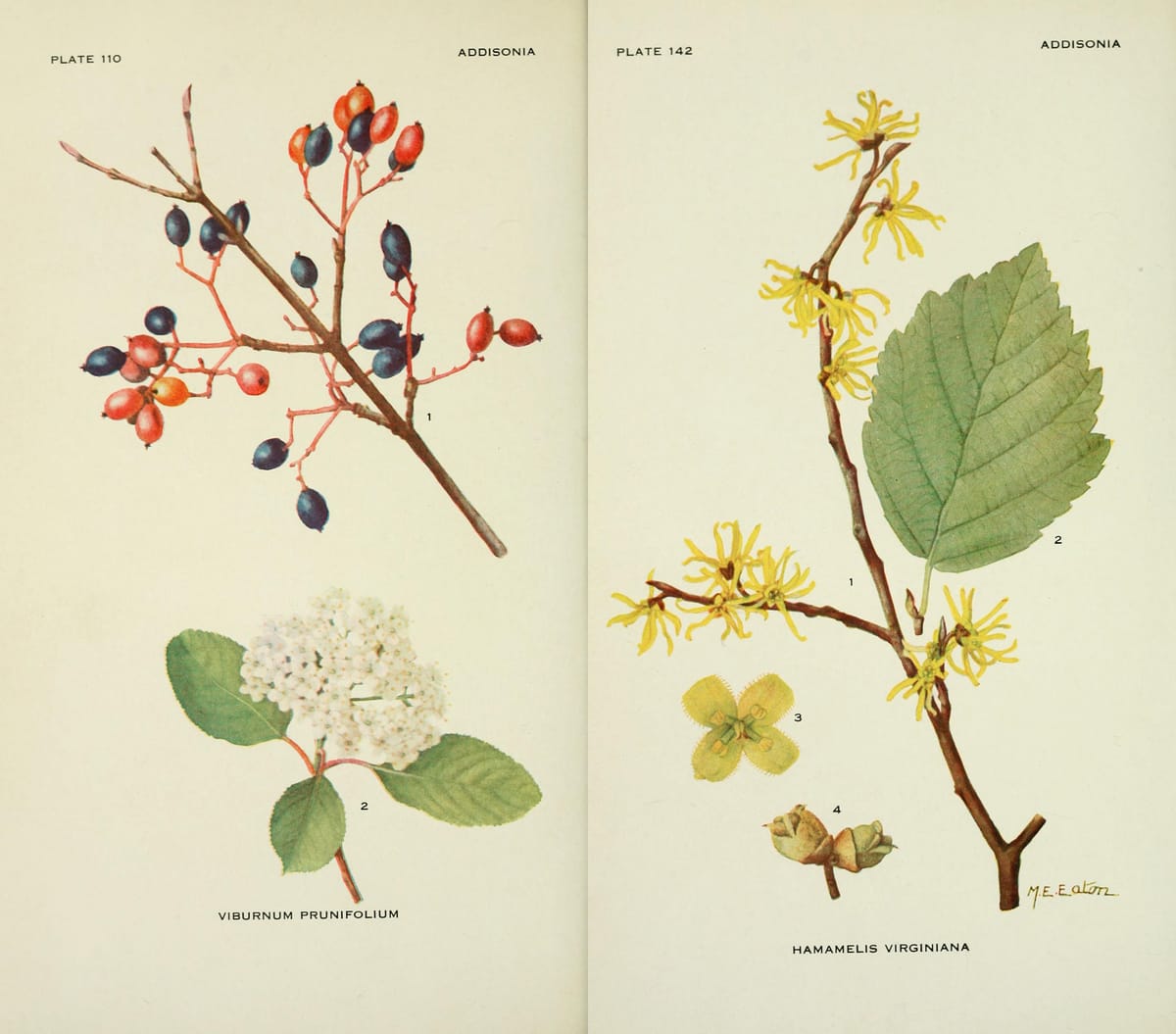
I think shrubs are widely considered a boring subject, but they might be my favorite category of plants. I’m a structure girl, a greenness gardener, a perennial devotee, plus it’s such an incredibly broad and diverse category! From smaller woody plants one might not think of as shrubs to big, tree-like specimens, and everything in between. Of course, most shrubs are flowering shrubs, and I’m the oddball who doesn’t want an overload of flowers to think about. So I’ve been on a deep dive into the world of shrubs looking for candidates that are aesthetically appealing to me, in line with my future forest-feeling goals, well suited to the site conditions I have to offer, and ecologically beneficial (i.e. native) to my location here in Upstate NY. And my wish list has done some growing.
First a correction: In the Keystone Plants post, I claimed to have a Black chokecherry (Prunus virginiana) out back that began life as a tiny whip given to me by a friend. That plant is a Black chokeberry (Aronia melanocarpa), which would be on my wish list if it weren’t already in my possession, so I just need to pick a good spot for it. It might be a long time before it looks like much, but is on a path toward 8-10' of bushy greenness, white early-summer blooms, red fall foliage, dark purple berries into winter, and copious benefits to pollinators and butterfly larvae. So, welcome!
I’ll note that I have already planted several beauties here that I can and likely will happily repeat, especially Nannyberry (Viburnum lentago) and Serviceberry (Amelanchier).
I’m also adding Highbush blueberry (Vaccinium corymbosum) to my list, if I can work it into my future kitchen garden. And remember I already added Mountain laurel (Kalmia latifolia) to the list when we talked about Evergreens. So here are the handful of additional shrubby contenders that I’m adding to the list today—
1) Witch hazel (Hamamelis virginiana)
I’ve noted before that I don’t generally love yellow in the garden, and witch hazel blooms yellow, but I’m drawn to it for a lot of reasons, including its benefits for both insects and humans. At 10-20' with tree-like tendencies, it could be just the right size for the future courtyard. And Hamamelis virgininia (unlike other witch hazels) is a late bloomer — pale yellow blooms in the fallscape could be lovely, and they can even hang on into December.
2) Smooth blackhaw (Viburnum prunifolium)
As noted, I’ve already got a couple of Nannyberry viburnums in the ground but I might want to throw a Smooth blackhaw into the mix. It can also get to ~20', with creamy flower clusters in spring followed by dark blue berries. And among its many fine qualities are that it can be trained as a small tree and is drought tolerant, my favorite trait in a plant.
3) Sweet azalea (Rhododendron arborescens)
I’m reluctant to plant a rhododendron in our small space even though it would be evergreen (I haven’t totally ruled it out) but the smaller-stature (8-12', and deciduous) sweet azalea has its appeal. But it might want more water than I have for it. It would be yet another creamy-white spring bloomer, for better or worse.
4) Winged sumac (Rhus copallinum aka shining sumac)
I’m kind of obsessed with this one, as I love both the foliage and the greenish flower clusters, and it reaches ~10' in height. It wants to form thickets so I might have to keep an eye on it, but it would be hard to take my eye off it, so that’s fine.
5) Ninebark (Physocarpus opulifolius)
I can't count the number of times I’ve wandered past a table of native plant babies and went “ooh what’s that ... right, ninebark.” It calls out to me every single time, but I’ve successfully resisted buying it without a plan. I now know it can grow anywhere from 3-10', has white spirea-like flower clusters, persistent fruit pods, is fast growing, non-fussy, insect and disease resistant and drought tolerant. So that’s a hell yes.
All four of these are host plants to various butterfly and moth larvae, and I’m very excited about this group of contenders. Although, as you may have noticed, these are all at the larger end of the shrub spectrum, so I’m still on the lookout for some lower growers.
And I also just had a thought about the flowers. I obviously lean toward shrubs that flower white or ivory (see also the multiple viburnums and oakleaf hydrangeas I’ve already planted here) and am always telling myself to diversify that, because I’m not interested in making an all green-and-white garden either. But maybe the way to think about it is that I use white-blooming shrubs and supplement that with the other-colored weeds and wildflowers (or forbs, a word I somehow just learned this week). That feels like a doable way for me to organize it in my head.
.
Illustrations by Mary E. Eaton for New York Botanical Garden, 1918-19 (now public domain), via the Biodiversity Heritage Library.