Playing Favorites: The unfairly maligned Lady Violet
She’s beautiful, assertive, even edible — what’s not to love?


Determined to get my hands on some of the sweet little spring ephemerals from my wish list before they slip away, and with my likeliest nearby source for them finally open for the season, I hauled myself out of my sick bed on Thurs, bundled a wool scarf around my throat despite the unseasonable heat, and met a friend there. I did happily come home with two of them — bloodroot and toothwort — but in the meantime, I’ve fallen in love with the tiny early-spring gem right under my feet. It’s Viola sororia, the common blue violet, which, at the 3-yr mark of our “neglect” of the grass, has all but taken over the backyard. (The front yard is more, hm, complicated.) A lot of people think of this natural beauty as a weed that spoils their lawn. For me, I don’t mind the violets in my grass so much as I mind the grass in my violets. But if the two could carry on just as they are at the moment, I’d be perfectly happy.
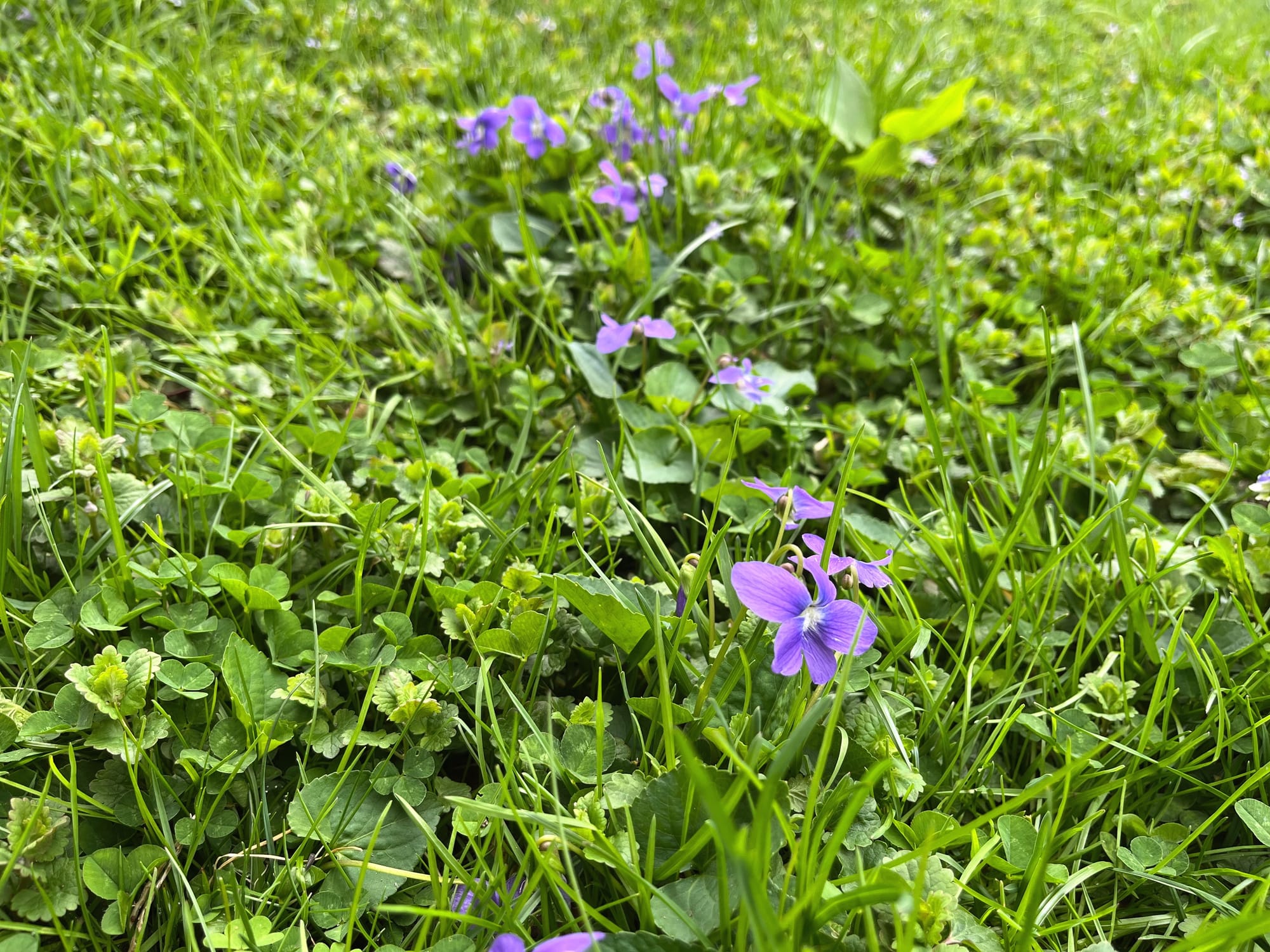
Before any of this started, I was feeling inspired by the Brits on IG posting their idyllic scenes of shaggy lawns strewn willy-nilly with blooming bulbs. I think of the daffodils and tulips here as being confined to well-marked beds (or containers), or at the base of trees, and love the look of them just traipsing all through the grass instead. And then, as if I’d somehow conjured it up, our grass turned green and became filled with violets — SO many more than we’ve seen so far.
Apparently its natural ease at reseeding itself is what gets it confused with invasive lawn weeds like dandelion, but it is actually just a beautiful little native in the eastern half of the US, beloved of the pollinators. It’s also the very same violet you pay so much for if you ever buy one of those edible-flower mixes in the herbs section of the grocery store. The blossoms can be candied, made into jelly, tossed into salads, or used as a garnish on anything from deviled eggs to baked goods. (I just learned the leaves are apparently also edible — the young shoots can be eaten raw and more mature leaves cooked down.) Seriously, what’s not to love?
For now, I’ve forbidden my husband from mowing, but I don’t honestly know what would happen if we just ... didn’t. Would the violets squeeze out the grass? Would they die back when it gets hotter and leave it that much more susceptible to the actual weeds? My long-term goal is no grass in the back (after starting with nothing but grass), and I think this year we might just do a mown path through what is still back there and see what happens in the unmown parts. Trial and error always.
But the violets are welcome to settle in anywhere they want, especially if they’d like to act as groundcover in the loosely defined beds. I even bought them a cousin while at the nursery on Thurs — white with purple streaks. She’s gorgeous.
PLANT DETAILS:
• Common blue violet (Viola sororia), native to almost the entire eastern half of the US (I believe 37 of the mainland states)
• Member of the violet family, Violaceae
• Clumps of heart-shaped leaves
• Iconic blue-purple blossoms with white throats, can bloom from March to August depending on location/climate
• Typically 6-8" tall
• Reseeds assertively to form a low groundcover over time
• Blossoms and leaves are both edible, blossoms commonly found in edible-flower herb mixes